F-150 Tow Guide: A Comprehensive Overview (Updated 04/28/2026)
Today’s date is 04/28/2026 12:07:19. This guide details F-150 towing, covering capacities up to 3000kg, engines, and technologies like Pro Trailer Backup Assist.
Understanding F-150 Towing Capacity
The F-150’s towing capacity isn’t a single number; it varies significantly based on several crucial factors. These include the engine selected – from the 2.7L EcoBoost V6 to the powerful 3.5L PowerBoost Full Hybrid – and the truck’s configuration. Key elements impacting capacity are axle ratio, cab type (SuperCab or SuperCrew), and whether it’s a 4×2 or 4×4 model.
Maximum conventional towing capabilities can reach impressive figures, as detailed in charts based on wheelbase (145.0″, 157.0″, 163.7″). Understanding Gross Vehicle Weight Rating (GVWR) and payload is vital, as exceeding these limits compromises safety and handling. The F-150 offers options for both braked and unbraked towing, with capacities differing accordingly – up to 3000kg for braked towing on certain models.
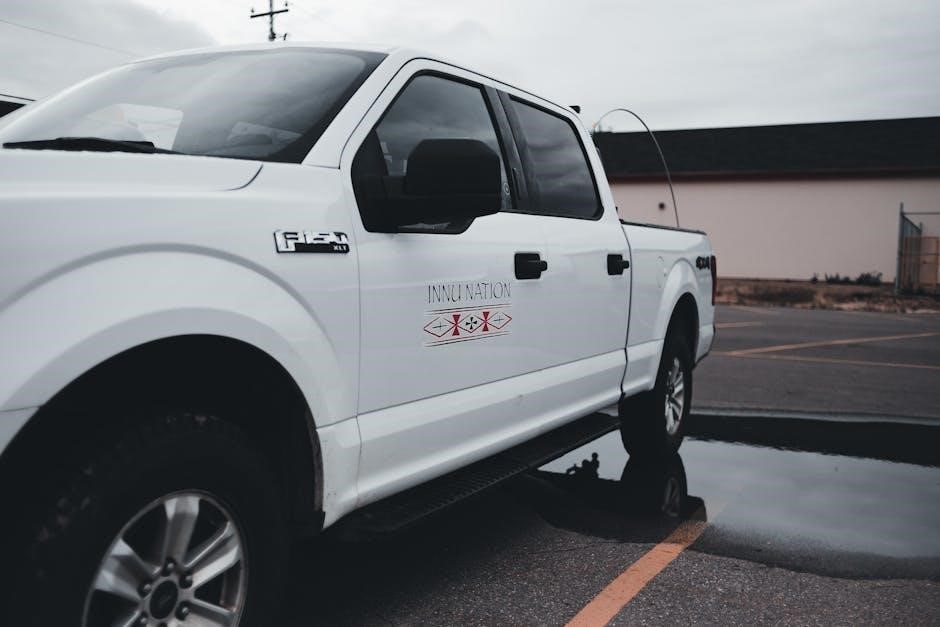
Key Terminology: GVWR, Payload, and Towing Capacity
Before towing with your F-150, understanding key terms is essential for safe and legal operation. Gross Vehicle Weight Rating (GVWR) is the maximum permissible weight of the fully loaded vehicle – including passengers, cargo, and the tongue weight of a trailer. Payload refers specifically to the weight of cargo and passengers inside the truck, and it’s calculated by subtracting the vehicle’s weight from the GVWR.
Towing Capacity represents the maximum weight the F-150 can safely pull. It’s crucial to remember this is separate from GVWR and payload. Exceeding any of these ratings can lead to diminished vehicle control, increased stopping distances, and potential damage. Always consult your owner’s manual and towing guides for specific ratings based on your truck’s configuration;
F-150 Engine Options and Towing Capabilities
The 2026 F-150 offers a range of engines, each with distinct towing capabilities to suit various needs. The 2.7L EcoBoost V6 provides a solid balance of power and efficiency, suitable for lighter towing tasks. Stepping up, the 3.5L EcoBoost V6 delivers significantly increased torque, enabling heavier loads to be managed with confidence. For those prioritizing traditional power, the 5.0L Ti-VCT V8 offers robust performance.
However, the 3.5L PowerBoost Full Hybrid stands out, combining the benefits of a gasoline engine with an electric motor, offering impressive towing capacity and enhanced efficiency. Choosing the right engine depends on the typical weight of your trailer and your desired driving experience. Always refer to official Ford towing charts for precise figures based on configuration.
2.7L EcoBoost V6 Towing Capacity
The 2.7L EcoBoost V6 in the 2026 F-150 provides a capable towing experience for many users, balancing power and fuel efficiency. Maximum conventional towing capabilities vary based on configuration, specifically wheelbase and axle ratio. For SuperCab models with a 145.0″ wheelbase and 4×2 drivetrain, the capacity reaches impressive levels.
However, opting for 4×4 slightly reduces this figure. Longer wheelbases, like the 163.7″, generally offer increased towing capacity. It’s crucial to consult the official Ford towing charts to determine the precise maximum for your specific F-150 build. This engine is well-suited for boats, smaller campers, and utility trailers, offering a practical solution for everyday towing needs.
3.5L EcoBoost V6 Towing Capacity
The 3.5L EcoBoost V6 engine significantly elevates the F-150’s towing prowess, offering substantial capacity for heavier loads. Like the 2.7L, maximum conventional towing is dependent on factors like wheelbase (145.0″, 163.7″) and drivetrain (4×2, 4×4). SuperCab configurations generally demonstrate higher capacities compared to SuperCrew models, particularly with the longer wheelbase.
This engine is a popular choice for those regularly towing larger trailers, such as sizable boats, travel trailers, or even construction equipment. Ford’s towing charts are essential for pinpointing the exact capacity for your specific F-150. The 3.5L EcoBoost provides a strong combination of power and torque, making it a reliable option for demanding towing applications, ensuring a confident and capable towing experience.

5.0L Ti-VCT V8 Towing Capacity
The 5.0L Ti-VCT V8 engine delivers robust towing capabilities within the F-150 lineup, appealing to drivers who prefer traditional V8 power. Towing capacity, as with other engines, varies based on configuration – specifically, wheelbase (145.0″, 157.0″, 163.7″) and whether it’s a 4×2 or 4×4 model. SuperCab options often exhibit slightly higher maximum towing figures than SuperCrew variants.
This engine provides a solid balance between power and dependability, making it suitable for towing substantial loads like large campers, horses, or work-related trailers. Referencing Ford’s official towing guides is crucial to determine the precise capacity for your particular F-150 configuration. The V8’s torque output contributes to a stable and controlled towing experience, offering confidence on the road.
3.5L PowerBoost Full Hybrid Towing Capacity
The 3.5L PowerBoost Full Hybrid engine represents Ford’s innovative approach to F-150 towing, combining gasoline power with an electric motor and lithium-ion battery. This configuration doesn’t sacrifice towing capability; in fact, it often enhances it, offering impressive maximum conventional towing capacities. Like other engines, specific numbers depend on factors like wheelbase (145.0″, 157.0″, 163.7″) and drive type (4×2 or 4×4).
The hybrid system’s electric motor provides instant torque, aiding in smoother acceleration and control while towing. Pro Power Onboard, available with this engine, adds versatility for powering tools or equipment at the job site or campsite. Always consult official Ford towing guides for precise figures related to your F-150’s specific build.

Types of Towing: Conventional, Gooseneck, and Fifth-Wheel
F-150 towing encompasses conventional hitch setups, robust gooseneck connections, and versatile fifth-wheel configurations, each suited for different trailer types and weights.
Conventional Towing Explained
Conventional towing, the most common method for F-150 owners, utilizes a rear hitch receiver and a ball mount to connect to the trailer’s coupler. This setup is ideal for a wide range of trailers, including travel trailers, boats, and utility trailers, with capacities varying based on the F-150’s configuration.
Understanding weight distribution is crucial for safe conventional towing. Proper tongue weight – typically 10-15% of the trailer’s total weight – ensures stability and control. Utilizing a weight distribution hitch can further enhance stability, especially with heavier trailers, by distributing weight more evenly across the F-150’s axles;
Always consult your F-150’s owner’s manual for specific conventional towing capacity ratings based on engine, axle ratio, and wheelbase. Remember to factor in the combined weight of the trailer, cargo, and passengers when determining if a trailer is within the F-150’s towing limits. Prioritize safety by ensuring the trailer has functioning brakes and appropriate lighting.
Gooseneck Towing: Advantages and Considerations
Gooseneck towing, while less common for typical F-150 use, offers significant advantages for hauling heavier loads. It involves a ball-and-socket coupling located in the truck bed, providing superior stability and maneuverability compared to conventional towing. This method is frequently employed for hauling large horse trailers, livestock trailers, and heavy-duty equipment.
However, gooseneck towing requires a specifically equipped F-150 with a factory-installed gooseneck hitch or a professionally installed aftermarket system. This setup reduces available bed space when not in use. It’s vital to verify your F-150’s gooseneck towing capacity, which will be lower than its conventional towing capacity due to the higher hitch weight.
Careful consideration of weight distribution and proper hitch installation are paramount for safe gooseneck towing. Always adhere to the manufacturer’s recommendations and ensure the trailer’s weight is appropriately balanced.
Fifth-Wheel Towing: Setup and Benefits
Fifth-wheel towing represents a robust solution for substantial towing needs, utilizing a specialized hitch mounted within the F-150’s bed. This setup distributes trailer weight more effectively than conventional hitches, enhancing stability and control, particularly crucial for larger trailers like recreational vehicles and substantial cargo haulers.
Proper setup involves securely connecting the kingpin of the trailer to the fifth-wheel hitch in the truck bed. Following display prompts and precise measurements, as outlined in setup guides, are essential for a secure connection. Regular inspection of the hitch mechanism is vital before each journey.
Benefits include increased towing capacity and reduced trailer sway. However, like gooseneck towing, a fifth-wheel hitch occupies significant bed space. Always consult your F-150’s owner’s manual for specific fifth-wheel towing limitations.
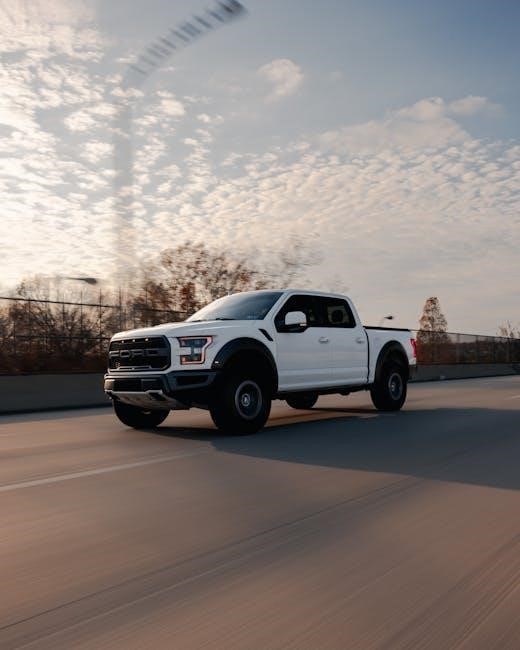
F-150 Towing Features and Technology
Ford’s innovative technologies, including Pro Trailer Backup Assist, Smart Trailer Tow Connector, Onboard Scales, and Trailer Reverse Guidance, simplify and enhance towing experiences.
Pro Trailer Backup Assist
The Pro Trailer Backup Assist is a groundbreaking feature designed to dramatically simplify the often-challenging task of backing up a trailer with an F-150. This system utilizes a knob on the dashboard, allowing drivers to steer the trailer with rotational control, rather than traditional steering wheel manipulation.
The setup process involves a straightforward six-step guide: positioning the truck and trailer correctly, diligently following the on-screen display prompts, strategically placing a sticker for calibration, and accurately measuring key dimensions. Once calibrated, the system takes over, controlling the trailer’s direction based on the knob’s rotation. This technology significantly reduces the learning curve for new towers and minimizes the risk of errors, making trailer backup a much more confident and controlled experience. It’s a game-changer for both seasoned and novice haulers.
Smart Trailer Tow Connector
The Smart Trailer Tow Connector elevates towing convenience by seamlessly integrating the F-150 with a compatible trailer’s electrical system. This intelligent connector goes beyond basic lighting functions, enabling features like trailer light-out detection, which alerts the driver to any malfunctioning trailer lights, enhancing safety on the road.
Furthermore, it facilitates communication between the truck and trailer, allowing the F-150 to display trailer tire pressure monitoring system (TPMS) data directly in the instrument cluster. This provides crucial information about the trailer’s tire health, preventing potential issues before they escalate. The connector simplifies the connection process and provides a comprehensive overview of the trailer’s operational status, contributing to a safer and more informed towing experience. It’s a vital component for modern towing needs.
Onboard Scales with Smart Hitch
Ford’s Onboard Scales with Smart Hitch represent a significant advancement in towing technology, eliminating guesswork when it comes to payload and tongue weight. Integrated directly into the hitch receiver, these scales provide real-time weight measurements displayed within the F-150’s information display. This allows drivers to accurately assess whether they are within the truck’s and trailer’s weight limits, preventing overloading and ensuring safe towing conditions.
The system also offers guidance on weight distribution, helping drivers optimize trailer loading for improved stability and handling. By providing precise weight data, the Smart Hitch minimizes the risk of exceeding GVWR or payload capacity, contributing to a more confident and secure towing experience. It’s a proactive safety feature designed for peace of mind.
Trailer Reverse Guidance
Ford’s Trailer Reverse Guidance system dramatically simplifies the often-challenging task of backing up with a trailer attached to your F-150. Utilizing the truck’s cameras and sensors, this technology provides visual cues on the center stack display, showing steering directions to guide the trailer precisely where you want it to go. It essentially overlays predicted trailer paths, minimizing the risk of jackknifing or collisions.
The system works in conjunction with the Pro Trailer Backup Assist, offering an additional layer of control and confidence. Drivers can use a dedicated knob to steer the trailer, while the system manages the steering angle, making even complex maneuvers feel remarkably easy. This feature is invaluable for both experienced towers and those new to towing, enhancing safety and convenience.
Weight Distribution and Hitch Considerations
Proper hitch selection and weight distribution are crucial for safe F-150 towing, ensuring stability and control while maximizing the truck’s capabilities.

Choosing the Right Hitch Receiver
Selecting the appropriate hitch receiver is paramount for safe and effective F-150 towing. Hitches are categorized by their maximum towing capacity and receiver tube size – typically 2-inch or 2.5-inch. A Class III receiver, commonly a 2-inch, is often sufficient for lighter towing needs, supporting up to 8,000 pounds. However, for heavier loads, a Class IV receiver with a 2.5-inch opening is recommended, capable of handling upwards of 10,000 pounds.
Consider the type of towing you’ll be doing. Conventional towing generally requires a simpler hitch, while gooseneck or fifth-wheel setups necessitate specialized receivers installed in the truck bed. Always verify the hitch receiver’s weight capacity matches or exceeds the weight of your trailer and cargo. Ford offers factory-installed hitch options, ensuring compatibility and maintaining warranty coverage. Aftermarket hitches are also available, but ensure they meet industry safety standards and are properly installed.
Weight Distribution Hitch Systems
When towing heavier trailers, a weight distribution hitch is crucial for maintaining F-150 stability and control. These systems redistribute trailer weight across all axles – truck and trailer – minimizing sag and sway. They accomplish this using spring bars that transfer a portion of the trailer’s tongue weight to the truck’s rear axle, improving steering and braking performance.

Proper adjustment is key; incorrect setup can negate the benefits or even worsen handling. Weight distribution hitches are particularly beneficial for longer trailers and those with significant tongue weight. They help restore the truck’s original ride height and handling characteristics, enhancing safety and comfort. Consider professional installation and adjustment to ensure optimal performance and compatibility with your F-150 and trailer combination.
Understanding Tongue Weight
Tongue weight is the amount of force exerted downward on the hitch ball by the trailer’s tongue. It’s a critical factor in safe towing with your F-150, typically ranging from 10-15% of the total trailer weight; Insufficient tongue weight can cause trailer sway, while excessive tongue weight can overload the rear suspension, impacting handling and potentially damaging the vehicle.
Proper tongue weight distribution is essential for stability. Always verify your F-150’s maximum tongue weight capacity in your owner’s manual and ensure your loaded trailer falls within this range. Adjusting cargo placement within the trailer is the primary method for achieving the correct tongue weight. Using a tongue weight scale provides an accurate measurement, ensuring a safe and controlled towing experience.

F-150 Towing Capacity Charts (by Wheelbase & Axle Ratio)
Maximum conventional towing capabilities vary by wheelbase (145.0″, 157.0″, 163.7″) and axle ratio, impacting the F-150’s performance significantly.
145.0″ Wheelbase Towing Capacities
The 145.0″ wheelbase F-150 offers a versatile towing foundation, with capacities differing based on cab configuration (SuperCab or SuperCrew), engine choice, and axle ratio. For the 2.7L EcoBoost V6, 4×2 models can achieve substantial towing, while 4×4 versions provide added traction for challenging conditions. Examining the charts reveals that higher GVWRs generally correlate with increased towing potential.
Specifically, SuperCab models with the 2.7L EcoBoost and a suitable axle ratio can often tow upwards of 7,700 lbs conventionally. Stepping up to the 3.5L EcoBoost or 5.0L V8 significantly boosts these numbers, potentially exceeding 10,000 lbs. The 3.5L PowerBoost Full Hybrid further enhances capability. Remember to always consult the specific chart for your F-150’s configuration to determine the precise maximum towing capacity, ensuring safe and legal operation.
157.0″ Wheelbase Towing Capacities
The 157.0″ wheelbase F-150 generally unlocks higher towing capacities compared to the shorter 145.0″ wheelbase, providing enhanced stability and control when hauling substantial loads. This extended length distributes weight more effectively, contributing to a smoother towing experience. As with the shorter wheelbase, engine selection and axle ratio are critical determinants of maximum towing capability.
SuperCab and SuperCrew configurations both benefit from the increased stability. The 2.7L EcoBoost, 3.5L EcoBoost, 5.0L V8, and 3.5L PowerBoost Full Hybrid all demonstrate increased towing potential with the 157.0″ wheelbase. Expect to see conventional towing capacities potentially exceeding 11,000 lbs with the more powerful engine options and appropriate axle ratios. Always refer to the official Ford towing charts specific to your truck’s configuration for accurate and safe towing limits.
163.7″ Wheelbase Towing Capacities
The longest wheelbase option, at 163.7″, maximizes the F-150’s towing potential, offering the greatest stability and control, particularly when handling heavy trailers. This extended length further optimizes weight distribution, minimizing sway and enhancing overall towing confidence. This configuration is ideal for those frequently towing substantial loads, such as large campers, boats, or equipment trailers.
Across all engine choices – 2.7L EcoBoost, 3.5L EcoBoost, 5.0L V8, and 3.5L PowerBoost – the 163.7″ wheelbase consistently yields the highest available towing capacities. Expect maximum conventional towing figures to potentially surpass 13,000 lbs, contingent upon engine selection and axle ratio; SuperCab and SuperCrew models both benefit. Always consult the official Ford towing guide for precise specifications tailored to your specific F-150’s build.

Safety Considerations When Towing with an F-150
Prioritize safety! Ensure proper trailer braking, monitor tire pressure diligently, and perform regular maintenance checks before each towing journey for peace of mind.
Proper Trailer Braking Systems
Ensuring adequate trailer braking is paramount for safe towing with your F-150. Modern trailers often utilize electric brakes, activated by a controller within the truck’s cabin, synchronizing braking force between the vehicle and trailer. It’s crucial to verify the trailer’s braking system is correctly matched to its weight; insufficient braking can lead to dangerous sway or extended stopping distances.
Regularly inspect brake lines, drums, and pads for wear and tear. Proper adjustment of the brake controller is vital, allowing you to modulate braking intensity based on load and road conditions. Consider incorporating a breakaway system, an independent emergency brake activated if the trailer detaches from the F-150. Always test the braking system before embarking on a long journey, confirming responsiveness and functionality. Prioritizing a well-maintained and appropriately sized braking system significantly enhances towing safety.
Tire Pressure Monitoring for Towing
Maintaining correct tire pressure is critical when towing with your F-150, impacting handling, fuel efficiency, and tire longevity. Towing significantly increases the load on your tires, necessitating adjustments beyond standard recommendations. Consult your F-150’s owner’s manual and the tire manufacturer’s guidelines for appropriate pressures when towing, often found on a placard within the driver’s side doorjamb.
The F-150’s Tire Pressure Monitoring System (TPMS) alerts you to low pressure, but it’s essential to manually check all tires – truck and trailer – before each trip. Consider using individual TPMS sensors for the trailer tires for comprehensive monitoring; Overinflating can lead to a harsh ride and reduced traction, while underinflation causes overheating and potential tire failure. Regularly inspect tires for damage, and remember that pressure changes with temperature.
Regular Maintenance Checks for Towing
Consistent maintenance is paramount for safe and reliable towing with your F-150. Before each towing journey, thoroughly inspect critical components. This includes checking the hitch receiver and ball mount for wear or damage, ensuring proper connection, and verifying the functionality of all trailer lights – brake, turn, and running lights. Examine the safety chains or cables, confirming they are correctly crossed and have sufficient slack.
Beyond the hitch, inspect your F-150’s brakes, fluids (engine oil, coolant, brake fluid, transmission fluid), and belts. Pay close attention to the cooling system, as towing places extra stress. Regularly check wheel lug nuts for tightness. A pre-trip inspection can prevent costly breakdowns and ensure a secure towing experience. Adhering to the Ford-recommended maintenance schedule is also crucial.